
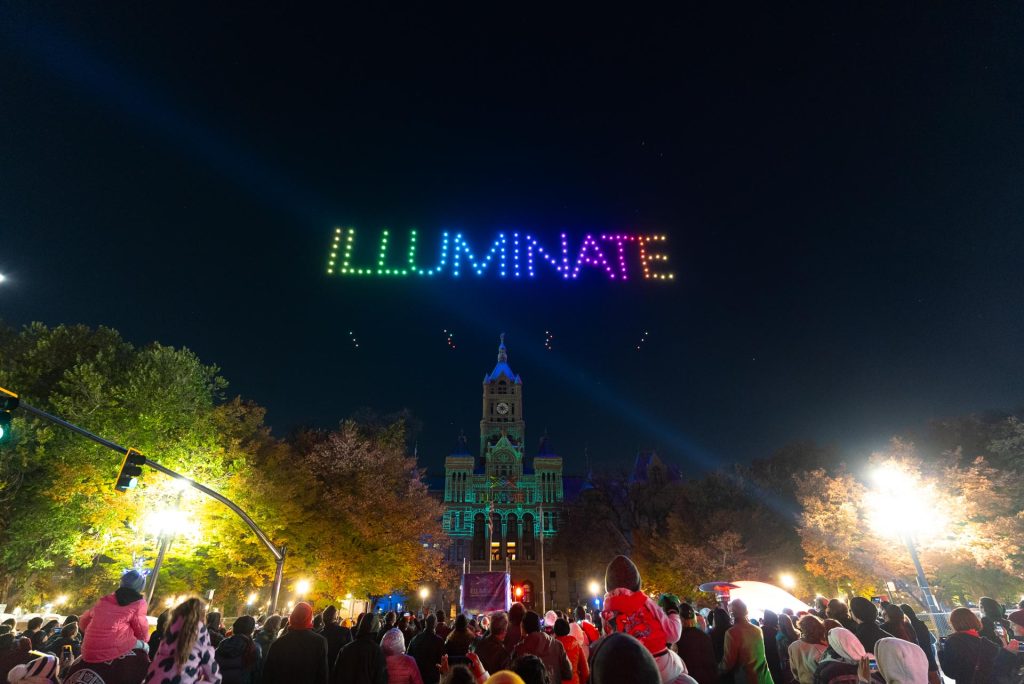
A drone show turns open air into a programmable canvas, where hundreds of synchronized lights form logos, characters, and full stories above a crowd. If you have watched one in person, you already know the reaction. People stop talking, lift their phones, and stare up.
That shift in attention is exactly why event organizers, cities, brands, and resorts are rethinking how they close a big night. Fireworks still have their place, but they cannot spell a word, animate a mascot, or count down to midnight with precision.
This article breaks down what a drone show actually is, who it works best for, how the technology runs, how it compares to fireworks, and how to start planning one. By the end, you will know whether this kind of aerial entertainment fits your next event.
What Is a Drone Show and How Does It Work?
A drone show is a coordinated flight of light-equipped drones that move together to create animated images in the night sky. Each drone acts like a single pixel. Together, the fleet builds shapes, motion, and depth that a crowd reads as one connected picture.
The process starts with software, not flying. Designers build the animation on a computer, then map every frame to exact drone positions and color changes. The drones follow those preprogrammed paths using GPS, so the show runs the same way every time.
A typical performance lasts 8 to 15 minutes. That length is shaped by battery life, but it also matches how long an audience stays fully locked in. Short, focused, and high impact beats long and repetitive.
How Many Drones Does a Show Need?
The right number depends on viewing distance and how detailed the animation needs to be. Smaller events often use 100 to 200 drones, while large public shows can use several hundred or more.
More drones mean larger images, smoother curves, and stronger visibility from far away. A backyard-scale celebration and a stadium finale call for very different fleet sizes.
Who Is a Drone Show Best For?
A drone show fits any organizer who wants a controlled, brandable, and low-risk aerial moment that an audience will remember and share. That includes cities, festivals, sports teams, resorts, and companies launching a product.
Brands lean on drone entertainment because it can carry a message. A fireworks finale ends in smoke. A drone finale can end on your logo, a slogan, or a call to action that lands while every phone is already recording.
Cities and venues often choose it for a different reason. Many sit near homes, wildlife areas, or dry landscapes where noise and fire risk create real limits. A quieter, spark-free option opens doors that pyrotechnics cannot.
Which Events Use Drone Shows Most Often?
The most common uses are holiday celebrations, sports events, festivals, corporate launches, and tourism activations. Each one benefits from a different strength of the format.
- Holiday events like the Fourth of July and New Year’s Eve use drones to cut noise and fire risk while keeping the visual payoff.
- Corporate launches use them to reveal a product, animate a brand mark, and create social-ready footage.
- Festivals and tourism events use them as a headline finale that gives guests a reason to stay until the end.
How Does a Drone Show Compare to Fireworks?
A drone show offers more creative control, less noise, and zero spark risk, while fireworks deliver raw scale and a long-standing tradition. Neither is universally better. The right choice depends on your goals, your venue, and your audience.
Fireworks create bursts of color and sound that feel familiar and big. They are loud, they produce smoke, and they require strict fire and safety clearances, especially in dry regions.
Drones create meaning instead of just bursts. They can spell words, build animated scenes, and integrate branding with a level of detail fireworks cannot match.
Are Drone Shows Quieter Than Fireworks?
Yes, drone shows are far quieter than fireworks. The fleet produces a soft hum rather than loud concussive blasts.
That matters more than people expect. Loud explosions can distress young children, pets, wildlife, and some veterans. A quieter format makes the event more inclusive and easier to host near neighborhoods.
Is a Drone Show Safer Than Fireworks?
A drone show carries less fire and debris risk than fireworks because it uses no explosives or burning material. There are no falling embers and no smoke cloud drifting over the crowd.
This is a major advantage in dry climates or areas with strict fire codes. The tradeoff is that drones depend on clear airspace approval and stable weather, which a professional team manages during planning.
What Can You Customize in a Drone Show?
Almost everything visual can be customized, including shapes, logos, text, colors, motion, and the music synced to the performance. This is where the format separates itself from any traditional display.
The design team starts with your message, then builds visuals that support it. A clean logo, a bold countdown, or a single animated character often lands harder than cramming in too many elements.
Music ties it together. Syncing the lights to a custom soundtrack turns a light display into a paced, emotional sequence with a clear beginning, middle, and end.
Can a Drone Show Display a Company Logo?
Yes, a drone show can recreate a company logo, sponsor mark, or product outline in the sky. The design team converts your brand files into drone formations.
Simple, bold logos translate best. Fine print and small details usually need to be simplified so they stay readable from the ground.
How Do You Plan a Drone Show?
You plan a drone show by locking in the date, venue, audience size, creative goal, and budget, then bringing in a professional team to handle airspace and production. Those five details shape everything that follows.
Lead time matters more than most people expect. Most custom shows need 8 to 12 weeks, and large public events or complex airspace can require several months.
Airspace approval is usually the longest step. In the United States, drone operations follow Federal Aviation Administration (FAA) rules, and authorization can take weeks. A strong provider builds the timeline around that reality so nothing gets rushed at the end. You can dig deeper into the full process in our guide to [INTERNAL LINK: drone show planning].
What Does the Planning Process Include?
The process moves through consultation, site review, airspace approval, animation design, setup, and live execution. Each stage feeds the next.
- The consultation defines your goal, theme, and venue so the team can recommend the right fleet size.
- The site review confirms a safe launch zone, clear sightlines, and no obstructions like power lines or tall trees.
- The animation phase delivers a storyboard and a 3D preview so you approve the show before a single drone flies.
What Should You Look For When Booking a Drone Show?
Look for a provider with strong safety practices, FAA permitting experience, in-house creative design, and a clear plan for weather. These four signals separate a reliable team from a risky one.
Use these questions to evaluate any company you consider:
- Does the team hold the proper FAA authorizations and handle permitting for you?
- Can they show real examples of custom animation, not just stock shapes?
- What is their backup plan if wind, lightning, or rain forces a delay?
- How do they secure the launch zone and keep the fleet a safe distance from the crowd?
- Who has final say on delaying or rescheduling the show on event night?
A confident provider answers all of these without hesitation. Vague answers are a warning sign.
Common Questions Before You Book
How long does a drone show last?
Most drone shows run 8 to 15 minutes. Battery life sets the ceiling, but the bigger reason is attention. A tight, well-paced show holds a crowd better than a long one.
Can a drone show fly over a crowd?
No, drone shows do not fly directly over the audience. The fleet performs in a controlled flight area with a secure launch and landing zone nearby. Your provider designs the layout so guests get a clear view while staying at a safe distance.
What happens if the weather is bad?
If wind, lightning, or heavy rain create unsafe conditions, the show moves to a backup time or backup date. A good contract spells out this process in advance, so decisions stay calm and clear on event day.
Can you see a drone show during the day?
No, the lights need darkness to read clearly. Drone shows are built for after sunset, when the LED formations stand out sharply against a dark sky.
Why a Drone Show Earns Its Spot on the Main Stage
A drone show has moved from novelty to a serious headline act because it combines visual scale with creative control, safety, and shareable moments in a way older formats cannot. It does not just fill the sky. It tells your story across it.
The format rewards organizers who plan early, keep the creative focused, and partner with a team that handles aviation, safety, and design under one roof. Get those pieces right and the night sky becomes the most memorable part of your event.
If you are ready to explore what a custom show could look like for your next event, visit us to request a quote or schedule a planning call. Start the conversation early, and give your audience a reason to look up.
